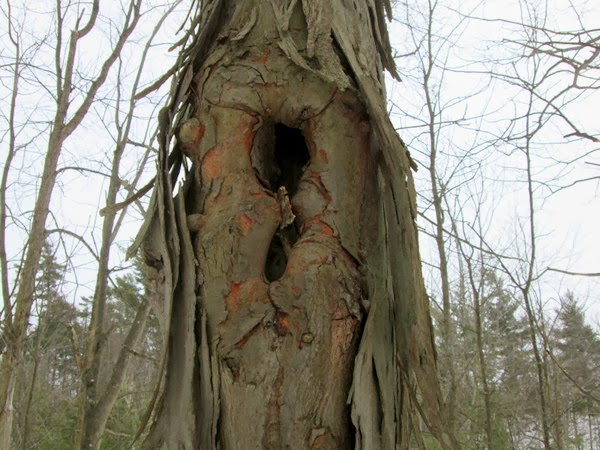
I often see a porcupine's trail in the snow going to and from dens in the craggy sides of the small sandstone valley we call Grouse Alley. This January I saw a dead porcupine not so much in a den as simply below a sandstone slab that angled out affording a few feet of sheltered ground. There was no snow covering the poor brute but it was frozen to the ground so we couldn't flip it over to see if a fisher had attacked its soft underbelly.
It looked so peaceful as if its quills had been stroked so I assume it simply starved. Some illness kept it from the nearby hemlock branches that it liked to nibble. That I wasn't going to see it perched high in a hemlock like I saw one in February 2008 made me a bit sad.
Melancholy is not something I generally drag around in the snow. Death usually stands out in the winter as the high point of any hike. A good carcass can bend my trail through the snow as the animals feeding on it slowly give me an anatomy lesson. The one on deer bones that I got from coyotes and crows in 2003 was most memorable.
The beauty of such remains leaves me speechless and when I see a live deer in the snow, I can't resist talking to it.
Back to this winter. That same day I also found a half eaten rabbit carcass not far from where I found the dead porcupine.
Leslie and I studied the snow around it and saw evidence that a hawk or owl might have killed it. Seeing fresh blood in the snow broadcasts the suffering of the victim but warms a cold day. Warmed the belly of the predator too. Leslie got the tail. The next snowfall covered the rest.
The mounting snow never covered the porcupine carcass. I kept an eye on it figuring that something would figure out how to neutralize those sharp quills and get to the meat, but nothing seemed to bother the dead porcupine. Then on March 3 with the first hint of a thaw in the air, though it was still around 20F, the rim of snow below the sandstone slab seemed to invite me to look over it again. The porcupine was still there but some of it had been scavenged. I could see its tail bones.
I continued down Grouse Alley, which was about the extent of my woodland explorations in the deep snow, far enough to check the sandstone dens where I expected to find another porcupine. I saw a relatively fresh trail in the deep snow from its den heading up and over the wave of snow enfolding the sandstone.
I admit that one has to have a brain numbed by winter to see that porcupine trail in the snow, but, a light brown helix in the snow flow down, it was there. Nice to know porcupines didn't face an epidemic, nice to know something was eating bits of the porcupine that died. But who? It didn't take long to find out. When I walked back through Grouse Alley, I found I was following a small flock of chickadees. I followed one right to the tail bone of the porcupine.
Nature has its ways of leaving suet out for the birds. It was no surprise to me. I once saw chickadees hopping in and out of a deer skull.
I kept checking the carcass expecting to see the rest of the bones picked clean. Instead on March 9 I saw snow piled on the porcupine remains and another pile of snow next to it with turkey feathers sticking out of it.
I strained to find prints in the snow but it was too deep to get close to the carcasses and I saw no clear prints in the trail I had made in the snow. Something had jumped off the trail that left four prints that a bobcat might fill.
When I looked a few feet farther down the trail, I saw another fresh mound of snow as well as what looked like claw marks in the wall of snow formed over an old downed log.
I had never seen anything like that before. The tracking guides say that fishers, bobcats, mountain lions and bears cover their kills. Bobcats are known to make scrapes, though the scrapes I saw seemed so finely sculpted in the soft snow that I got the impression that whoever made them was not distracted by covering up something it had just killed.
Maybe the turkey scraped the snow with its claws as it tried to escape. I thought of clearing away the snow to see what might be buried, but didn't. Wading in with snowshoes would make a mess of the site.
Predators bury their kills in expectation of returning to them so I decided to be patient. When I returned the next day, the pile of snow below the scraped wall of snow was undisturbed. But something had dined on the turkey and perhaps the porcupine. I could see more bones picked clean back at the base of the sandstone.
Then it warmed up. The scraped wall of snow collapsed and nothing seemed to have been buried in the snow below it. Bobcats also cover their scats. It might take a while before I see that. I saw no new tracks in the snow but when snow melts and then freezes again at night, a hard icy layer forms on top that grudgingly reveals tracks.
I have never seen a coyote, bobcat or fisher eating its kill, but I know that coyotes usually spread their meals leaving a mess behind. So I could eliminate coyotes from the list of diners, until I came back a few days letter and saw the scavenged bones spread out under the sandstone slab.
Hard not to see some significance in how the claw touched a well chewed bone, but I am sure there is none.
Then we finally had enough melting days and freezing nights to allow us to walk on top of the snow anywhere on our land, still on snow shoes, of course, to make the inevitable three feet deep plunge in the snow less onerous. We have one ridge mostly covered with juniper bushes and we take advantage of the few days a year we can walk on top of it. We do better than the deer but they know the best routes to get to juniper boughs they like to nibble.
The end of winter can seem a bit carefree and I was momentarily freed from my narrow path up Grouse Alley past the carcasses. Then as I came up a hill subdued by hard snow I saw some flecks of blood in the snow, looked down in the next ravine and saw the remains of a small deer.
I expected to see the tracks of a pack of coyotes around the carcass but saw nothing so obvious. The blood and bones seemed to cover everything. I didn't strain to identify tracks. This was not a crime scene, it was a meal.
Away from the carcass I saw scrapes in the snow.
But they looked more like the marks left by the tail feathers of a raven or crow. Not that I think this was any bird kill like the rabbit may have been or a bobcat kill like the turkey probably was. It looked like the deer was attacked while it slept.
And then the carcass was dragged through the bushes for about 10 yards. I couldn't have done what a coyote or two had done.
I doubted I would get back to this kill site. The next warm day will sink my free reign into still deep snow and with Spring, the honeysuckles, buckthorns, and prickly ash will rule not to mention the chickadees.
In the gentle afternoon light on a day at least 15 degrees below freezing, it’s easy to track trees. During a hard winter with constant snows and unrelenting winds, trees are about the only thing you can invariably track. Of course the only track a tree leaves is its long shadow and I am not inclined to mar the smooth snow with the pancake tracks of my snowshoes. In a hard winter the snow is that deep.
Of course the classic winter scene is graced with conifers
But that redundant green is best seen from afar, and the essence of tracking is to go mano-a-mano, so to speak, with one organism. That said, after a snowfall obscures the green above, the trunks of large hemlocks and pines are well worth handling.
The white snow does wonders for the complexion of trunks dead and alive. It even turns the tables on birch trees that in all other seasons come across as the lightweights of the forest. But in the deep snow, the yellow birch looks venerable.
Its bark looks like it has recorded all the sounds of the surrounding forest in a Braille ticker tape.
After a snowfall the white birch is not white at all and at a time when there is not a insect in sight, you can get bug eyed at what appears to be a coded bark with half the code already cracked.
I blush to say that in my greenhorn days when I didn’t dress warmly enough for the winter woods, I tore off birch bark for insulation, so my feeling that birch trees always look cold is probably not fair to the birch. But there are trees not any bigger than the birch that give the impression of being quite toasty in the cold.
Indeed ironwoods can give their impression that they are shedding in the snow and I might go so far as to say they are the hot irons of the woods but what flame appears to be in the bark is so grayed over.
And the shag-bark hickory quite eclipses the ironwood in that regard, after it all it is one of the few trees named after its bark.
While the spring buds and fall nuts of the shag-bark are sights to see, the tree shines in the winter snows. Compared to the other large hardwoods, white oak, red oak, and sugar maple, the hickory has a modest crown. In the winter with its beckoning bark it’s hard to miss.
One of our winter chores is to look for dead and sickly trees worth cutting for firewood. As we wended our way through our valley in the so-called dead of winter, we kept seeing shag-barks everywhere. By the way, after 15 years not one has died on our land and none look sickly. We marked one for possible sacrifice and then quickly reconsidered. It was too close to one of the god-like trees in our woods.
The shag bark we want to cut was growing from the seeds or root of that Darth Vader, no sense raising its ire.
It always behooves a naturalist to try to say something half scientific and I can make one stab at that. The trees with expressive bark that are so notable in the winter avoid the lichens that can turns trees with predictable bark into unseasonable pastels. In our woods the bitternut hickory suffers most in that regard.
In the state park, the red oaks can be coated with a sickly green.
However, most flatter barked trees get by with just a lichen badge
or more subdued gray lichens.
a fate the rougher barked trees seem to avoid.
(Many of my stabs at science have stood for years before I see something to prove me completely wrong. This stab lasted less than 24 hours after first writing it. On my hike the next day, I saw this shag-bark hickory
with a slight green blush of lichens on its bark.)
But eerie beauty of the winter woods argues against worrying about science. The trees after all seem quite cut off from their roots, one source of their life, and all the life giving foliage on top has fallen by the way side also unseen under the snow.
What is left is the only things solid in a world momentarily gone soft. And as the cold works on my brain I get this vision that these are pillars foraged of iron from the earth‘s hot core. Doesn’t their heat begin to melt even the ice ringed below?
Idle but warming thought for me, but other animals count on that melting.
I am not sure why seeing a porcupine's trail in the deep snow makes me philosophical.
Perhaps it's because of the limited range of a porcupine. When the snow is deep, it doesn't take as long to find its den. Less trudging through the snow, more thinking.
Of course, I can track beavers to their holes in the ice that leads to their lodges.
But porcupines are there for the touching, though I won't advise that. Leslie followed the trail while I took a photo of the porcupine's recent meals, patches of gnawed bark up pine tree trunks.
When I got to the tree where the porcupine had its den I told Leslie I didn't see it and she told me to get closer. I saw the quills, but, didn't thrust the camera close to the porcupine.
Not that porcupines panic when they are in their den. Last March I got a photo of a porcupine that didn't quite fit into the trunk.
I was impressed that its quills were relaxed. Being inside the trunk of a large tree must be therapeutic. No doubt a porcupine finds its center inside a tree.
But philosophically speaking there is no center in the woods. Stepping back from the tree, the porcupine's tracks in the snow proved that.
Turning around I saw further proof in the continuation of the porcupine's trails in the snow.
If only I could have climbed the tree and taken a photo from the top to make apparent how the woods stretches the brain of the animal that thrives in it.
At this time of year I make my own presence felt in the woods, not as the ever philosophical tracker but on my own account. I cut down trees for next winter's firewood. Logging, for I do drag logs out, is universally depicted as a heroic act, and what I mean by "heroic" is unthinking. Man sees tree, chainsaw roars, and timber the tree is down on the ground, especially when a mass of men sets out to level the trees for profit. But one person in the woods in the winter, colder the better, with only a hand saw begins to get an inkling about why the mammalian brain is shaped with such convolutions. The brain must comprehend four dimensions in a deceptively unpredictable realm. Trees hang around a long time and each has its quirks.
Let me hasten to add that this is not an instantaneous realization, not instinctual fear of the dark woods. It grew on me. I evolved to the point where the woods became my brain. Animals come to this realization much more quickly since their survival depends on it. Plus the brain of any tree climbing animal like the porcupine must evolve beyond our flat screen thinking cap.
Of course, I can't illustrate all that with photos but toward the edge of the woods I stumbled upon the works of a smaller porcupine. Its gnawing on a pine tree seemed large enough
But the den was just a few feet away
Note the smaller trough and the bark stripping at the base of the smaller tree. This porcupine didn't have the brain yet to command the woods with the elegant curves and angles of it deep troughs (deep thoughts). It climbed the nearest trees and stripped what may.
Now brainy as I make myself out to be, did I make any scientific observations to prove this not uninteresting distinction between the foraging of mature and immature porcupines, for example, try to eyeball this less venturesome one and prove that it was indeed smaller?
No way. Too damn cold for unpaid work. The golf course between me and home was a few feet away. Once again I had the cold wind blowing my brain back to its puny size. No wind chill in the woods. How my brain can stretch there,
though if you saw me you'd think I was just looking dumb up into the trees and not see the man looking for his god.