I was sitting on the ridge waiting for the beavers to come out, when I saw a deer browsing along the far end of the beaver dam getting her nose down into the delicate floating vines just behind the dam.
Deer are fat with beauty in August. There is too much to eat and their fur blushes over their supple muscles.
She waded out in the pond and I spotted the bobbing nose of another deer, and yet another deer came over the dam into the pond.
A buck raised his head and his antlers under wraps until rutting season. Meanwhile the browsing doe was herself browsed by some attacking insects.
She stepped back, twitching, muscles bulging. The video I took confirmed the impression I got that she was bigger and probably stronger than the buck. And did they bump noses briefly? Perhaps he is her son, not a potential mate.
I focused on the buck as he coolly stepped where the doe had been and then he recoiled from the insects without losing his cool. Bucks are more prone to stand their ground.
It’s easy focusing on a buck. His antler is a lightning rod for metaphors best avoided.
There’s nothing remarkable about seeing bucks anywhere now. Last July I saw three in the front yard of my father-in-law’s house in suburban Philadelphia around nine o‘clock at night.
But there is something about a beaver pond that seems to bring antlers down to earth and enhance the beauty of all deer, especially in August.
The ponds are more or less the low points in the deer’s world.
The hunters tell me that the deer know when it’s hunting season so perhaps the deer enjoy the ponds in the summer because they know they can’t be shot at. But the ponds are also shallow then and the deer can wade out and get some wet vegetables just at the time when plants on the hills begin to dry out.
Because of hunting which lasts 3 months in the fall in most of the state park (quieter bow hunters usually), I don’t track deer. I’d hate to make them feel like they are being hunted all year. I just bump into them and ask how they are doing.
Deer are too sensitive for their own good. Their eyes are big; their nose too; and their ears are huge and flexible. Such awareness might make them skittish and prone to run, but instead, especially in the woods, they seem to use their senses to double check the danger with a long look, smell and listen.
Running in the woods is often their downfall. Almost every winter I will find a full grown deer dead on the down slope of a wooded valley, probably because coyotes chased it and it slipped.
But August is not the time to talk about dead deer. They are radiant in August. I think deer should be made America’s sacred cow and August the holy month to worship them before they get their dull brown but more serviceable winter coat.
I pushed off in my kayak an hour before dawn on August 5. I didn’t mind that it was the coldest dawn of the summer, dipping into the 40s. The chill would delay the sweat I was bound to get. I had a 45 minute paddle to Quarry Point on the east end of Picton Island.
I soon decided it might take longer because the west wind began picking up. I was heading with the slowly rising sun an hour away from being at my back.
I like paddling into darkness. The gulls and terns flying above impressed me as celestial objects. The heron standing on a rock in the Narrows didn’t flinch from its gargoyle pose as I paddled by it. Of course the gulls, terns, and heron trained their hungry eyes toward the light. When I turned around and saw how bright it was in the east, I dipped my head toward the dark water and paddled harder.
I needed light to see the otters but I wanted to be still, low and quiet in the water as the light revealed their black dives in the suddenly green and then blue river.
I went to the area off shore where I always go, and wouldn‘t even be diverted even by my own theories.
The last few times I had come out at dawn, in 2012 and 2011, I had noticed a goodly number of seagulls in Picton channel flapping over the water where the otters were fishing. Based on that experience, I theorized that a good strategy for finding otters at dawn was to follow the gulls. The gulls I saw at dawn August 5 were not going toward Quarry Point nor Picton Island.
Forget gulls, I ducked closer to the dark water and out of the wind that wouldn’t quit, and stayed my course. That didn’t relieve me of gloomy thoughts.
I had been out of the zone for years. From 1997 to 2005 I had a feel for where the otters were. I made about $1000 taking people out to see otters on Wellesley Island. But that was when mother otters used the beaver ponds to raise their pups.
Then the beavers ran out of bark to eat. Six large ponds became six large meadows. Only three ponds remain. I see evidence that an otter visits, but no evidence that any otter lives there like in the old days.
And then there’s trapping. About 10 years ago the price the Chinese paid in auction for otter pelts tripled. The State of New York offers a six month virtually unregulated season to trap furbearers including otters with no bag limits. You just can’t shoot them but many do.
Finally before I venture out at dawn in my kayak, I usually scout the shores of Picton from my 14 foot motor boat looking for fresh otter scats. This year I saw week old scats now and then, but never a fresh scat. For the past 12 years fresh scats in the summer and fall always enticed me out at dawn. Not this year.
I suppose I went out on August 5 without checking the day before because I didn’t want to cloud my resolve with negative anticipations as I made the long paddle.... Sweat and no gulls didn’t help.
The wind slowed me down, and I’m getting old. It was so light as I approached Quarry Point that I could see a deer drinking along the rocky shore.
I had no theories about whether seeing a deer improved the odds of seeing an otter. The west wind made it harder to see otters in the river, but at least blew my scent away from where I expected the otters to be. I saw a splash in that direction.
I had been hearing lazy fish splashes all morning, but this one looked and sounded more dynamic. I thought I saw a black head in the water so I dropped the binoculars and trained the camcorder on the area.
I saw at least two otters, maybe three, all diving and swimming toward and then along the shore. Perhaps because they sensed me they all headed toward the rocky shore. I heard the characteristic snort and looked in the right direction but focused on the water. The center of the photo below, lifted from the video I took, shows where I looked.
The video provides a brief glimpse of an otter on the rocks in the upper right quadrant of the video. Then I stopped hearing snorts and saw nothing. Then what I thought was a shadow in the rocks began to move,
And snort. I’ve come to appreciate many things otters do. Seeing them catch fish ranks as number one. Punctuating their swimming with porpoise-like leaps in the air comes in second. But, for me, the earth stands still when an otter poops.
It evidently means a lot to otters too. This one turned to me, as its tail continued to pulse and wave, as if it was quite proud.
But perhaps I flatter myself. The snorts were surely directed at me. I’ve heard many snorting otters and interpret the sound and accompanying gestures as more dismissive than defiant. Otters don’t think we are in the same league. When is the last time you jumped in the river and came up with a fish in your mouth?
But the otter might have been looking beyond me. The sun had just risen.
All our gadgets mark the time. According to my camcorder the otter pooped at 6:16. The same gadget stamped my photo of the dawn 6:17. The otter retreated into the rocks. I continued to hear snorts, but didn’t see the otter among or on the rocks lining the shore.
I wasn’t exactly back in the zone, but I felt in good odor with otters again. As I paddled along checking rocks for fresh scats or, in the case below, fresh otter urine
I saw a mink scampering along the shore. A mink looks quite small after seeing an otter.
Then I paddled toward the dawn. I heard loon calls out in the expanse of Eel Bay.
But not in the direction of my breakfast.
While I was elated, I didn’t see enough of the otters to know who they were. The grand tail raising poop is characteristic of a male and the smaller otter or otters seemed more capable than pups born around April, as all North American otter pups are.
Ten days later I walked around the East Trail Pond in the middle of the day. I knew I probably wouldn't see any beavers but I wanted to walk around and see what they have been up to without disturbing them.
Then as I was sitting up on the ridge north of the pond I got a glimpse of an otter swimming past the lodge the beavers abandoned and heading toward the dam.
Trying to take a photo and get a video, I missed seeing the otter go over the dam. Nice seeing an otter in one of the remaining beaver ponds, but this was the pond where I used to watch a mother otter teaching her pups how to be otters, like the lesson below on a rainy afternoon in early August 2003.
The otter I just saw was probably a touring male, perhaps the same otter I heard under the ice of the pond back in the winter. It seemed to be alone then, too.
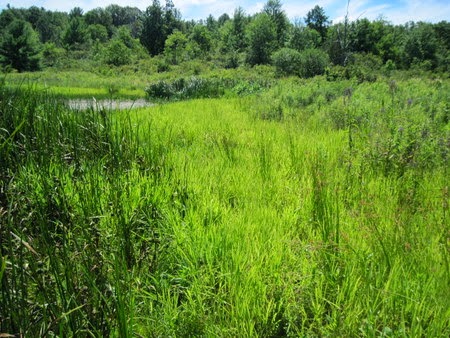
A meadow sounds like a nice place to take a walk, but I’ve learned that beaver meadows challenge the pedestrian. Beaver ponds look level but the pond bottom isn't. What I call the Big Pond was once a 5 acre pond. Now it's a meadow and it's easy to see that it’s not a walk in the park.
Indeed there is an oval of very shallow water quite appreciated by frogs.
When beaver ponds drain they are ready for the plow. Beavers rib their ponds with channels and holes, and they don’t remove the stumps of the trees they cut. So walking through a beaver meadow can be up and down with a stumble or two. However that roly-poly seems to vary the vegetation that naturally reclaims a drained beaver pond.
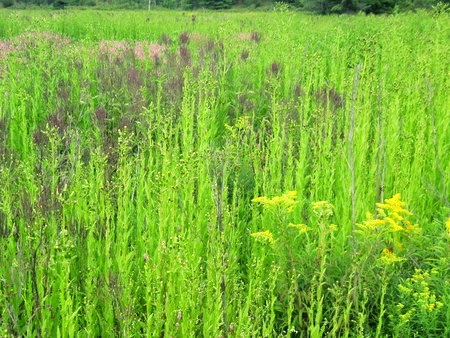
I took the two photos above on July 25, five months to Christmas. I usually think summer reaches its maximum by July 25, but meadows don’t. The goldenrod is not out in full force. On August 4, as thunderstorms moved to the north of the Big Pond meadow, the goldenrods began to make a showing.
Four months before Christmas, August 25, the goldenrods made a show:
And there was more. The goldenrods offered the yellow blooms, but the tall weed that lent a yellow sheen to everything was the most virulent crop of pilewort that I have ever seen.
Pilewort is the flower that never blooms. What looks like its buds simply puffs out in fuzzy seeds. (And yes, something in the plant is used to treat those piles.)
Usually it is confined to the dam for the very good reason that when the beavers were here, the dam held back acres of water. Here is what the Big Pond looked like in late August 10 years ago.
A beaver pond reflects the beauty of all around it and conceals a rich underwater world, but there’s a lot to be said for the delicate colors in the beaver meadows this August.
Behind the yellow of the goldenrods and pileworts were the exhausted crowns of blue vervain. In July I found a potent blue line of flowers
A month later the stalks were willing but the flowers were shot.
The bright pink flowers of the knotweed, usually confined to the dam and shallow waters of the pond, took up the slack.
Knotweeds are usually side shows, but this year pink was marching over the meadow.
There were no knotweeds along the dam, I assume because the dam did not back up any water this summer and just slowly dried out. The goldenrods, pileworts and vervains flourished there.
And as always there was the cutting grass. That grass had ended my wearing short pants on a summer hike. But this year it seemed about half its usual size. I could walk easily below the dam.
Those who argue that every beaver pond is a miracle of diversity will look askance at any assertion that there’s as much life in a beaver meadow. This is the third summer of a meadow where the Boundary Pond on our land once flourished. The first summer when the old pond was first drying out was typically colorful with bur-marigolds blooming in September where the ground just dried out.
The second summer was dry after a winter in which for the first time in 5 years that the valley wasn‘t flooded. The bur-marigolds were huddled along the remaining narrow channel of water.
This year there is a mix of goldenrods and bonesets engulfing the swamp milkweeds.
The boneset really took over
One morning I had finished sawing up a dead ash tree on the shady side of the valley and decided to go straight through the boneset in the middle of the valley to get over to the sunny side and saw down another dead ash tree. On my way, I bumped into a tiny tree frog up on one of the higher leaves of a boneset plant almost as tall as I am.
At first I thought it was a spring peeper because it was so tiny.
But on closer look, I didn’t see the X on the back that usually marks the peeper and the little thing had the shape of the gray tree frog.
It seems some tree frogs get their start on tall weeds, in this case high in a meadow, higher than the pond water ever reached. Of course bees are busy in many of the blossoms. On September 1, I got some video of the late season pollinators and even sneaked up on a grasshopper.
One summer I’ll have to try to see the progression of blooms through the bee’s senses. Is it relief or alarm when it drops down from the intricate bloomscape of the goldenrods and is almost swallowed by the bur marigolds?
Meanwhile most of the colors at the Big Pond meadow dulled, to the disappointment of Leslie,
but where the bottom had been wet enough the bur-marigolds made their bold September entrance.
In that same moist area the red knotweed still had some life.
Thus ends a beautiful summer for meadows.