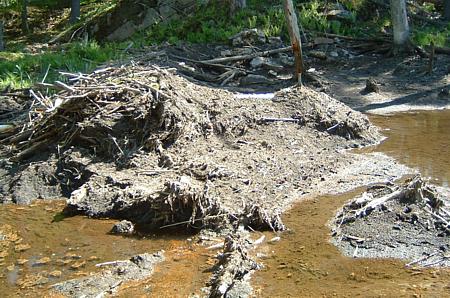
June is the time to begin looking for evidence that beaver kits are being fed in the lodge. Over the years I’ve spent many an evening on the banks of the Lost Swamp Pond doing just that but for the last two years, as far as I could tell, only one beaver was living in the Lost Swamp Pond. Ergo no kit watch there. But this April and May when I noticed sure signs that there was still a beaver lurking in the pond, I also got the impression that compared to last year the lurker was a bit more on the ball. The leaky dam had been repaired and the pond’s water level was rising.
Last year the dam seemed neglected. So I hoped that maybe the lurker now had a companion.
In the past two years, I had seen the lurker in the day, which was convenient. It’s slow business looking for one beaver in a large pond as night is coming on. So on June 2 I visited the Lost Swamp Pond in the late afternoon on my way to the East Trail Pond where I had a good chance of seeing 3 or 4 beavers out before my dinner time.
In every visit to the Lost Swamp Pond over the past 19 years, I always respected it enough to sit for 20 minutes with a full view of the pond and another 20 minutes by the dam. But last year I began cutting my time a bit shorter. On June 2 I saw that the beaver had added more honeysuckle branches to the lodge.
Indeed it looked like a cache was growing on one side of the lodge.
Beavers make caches of winter food in the fall. Maybe this spring cache was a gesture by the lurking beaver to show another beaver that there was still life in the old pond and the old beaver.
I soon saw something swim out of the lodge, but it had a rotating tail, a muskrat.
Exactly where I was hoping to see the beaver.
In other years the pond was crowded with muskrats who had divided the pond into at least three territories and sometimes I witnessed some pretty vigorous defenses of those territories. But this year, as far as I can tell there are only a few muskrats centered behind the dam, all friends or family. I still waited for more muskrats, I like muskrats, but none appeared so I walked around the west end of the dam toward the lodge.
Nothing makes you feel quite so foolish as being within a few yards of a beaver and not seeing it. The vegetation along the north shore of the pond was high enough so that all I heard was a loud splash and all I saw was a pulsing wave in the pond.
Only a fleeing beaver makes a pulsing wave like that. It never surfaced. I continued on and saw the well shaded bare ground where it had been sitting.
There are two ways to regard a beaver finding shelter on shore during the day. It’s lonely and wants a change of scenery or the lodge is crowded with new born kits and its in the way. I also saw some just cut honeysuckle out on in the pond.
It seemed they were destined for the lodge, perhaps a sign of another beaver at least. I have seen some thin honeysuckle branches with bark stripped by a hungry beaver
but I think the bushy honeysuckle branches are primarily used to shade the lodge.
Up at the dam I saw that more mud had just been pushed up on the dam and the water level was even higher.
Then I continued on to the East Trail Pond. On May 15 I had seen 4 beavers there and had every reason to believe that there would be new kits this year. My trips to the pond are not as frequent as I would like but I don’t want to habituate these beavers to being watched by humans because they are right off a park trial. So I vary my viewing spot. The best spot up on a ridge north of the pond is a few feet off the trail. On the 2nd I went to the south end of their dam.
By the way there are narrower places in this valley to put a dam, indeed the pond was once 3 times as big thanks to a narrow dam between two ridges. But 4 years ago this family saw its narrow dam in a neighboring valley washed away twice thanks, I think, to strong gusts during thunder storms.
So the beavers made this dam less prone to that type of disaster.
As you can see I came when the pond was still bathed in sunlight, but over the years I’ve often seen beavers of this family out in the day. I’ve followed the family for over a dozen years, obviously not the original bunch I saw in 1999. I was able to follow them because they had their kits in ponds within a half mile of each other. All the ponds they used in the last 10 years (I call them Meander Pond, Thicket Pond, Shangri-la Pond and the new East Trail Pond) could not fill the Lost Swamp Pond. They survived by dredging during drought summers. They were often constrained to having just one lodge and were slow to make another, as they did here last fall after spending two winters here. And perhaps because of that, over the years I have often seen a member of the family out in the pond during the day. I’ve seen the whole family out in the fall at noon when there was work to do.
By June, in the East Trail Pond, the winterberry was leafing out and the ferns growing. I feared I might have to stare into the green to see a beaver.
But soon enough one swam out of the green vegetation more or less toward me. Once again I saw a beaver vary its spring diet by sucking up the pollen that can coat the surface of a pond.
When the beaver left the pollen zone and cruised through unflavored water, if you will, it veered toward me.
I hoped it would come up to get some bark from a maple tree that the beavers had cut and that had blown over
But no such luck. It headed back to the greening shrubs in the middle of the pond.
On June 8 I made the same tour, this time with my 26 year old son. As we came down to the south shore of the Lost Swamp Pond, I saw large ripples. I expected to see a goose or two, but it was a beaver.
It turned toward us and promptly turned around. I expected a tail slap but none came.
It swam to the middle of the pond and I expected it to go into the lodge. Instead it went to the dam, rather far away, and when I focused on the dam, I saw a beaver up on the dam and another in the water behind the dam.
Soon they were both in the water swimming back toward the lodge in the middle of the pond.
The larger seemed almost to swim up on the back of the smaller and then it dived and surfaced far ahead of the other beaver, which briefly gave my son and I the impression that there were 3 beavers in the pond.
The smaller beaver dived into the lodge and the larger swam back to the dam, not sure why, and then swam passed the lodge and up into the southeast section of the pond. I got a picture of the changes to the lodge and, probably, the beaver who made them.
Of course I was excited to see two beavers in the pond. Pairing up is natural, of course, but the days when this pond was surrounded by other active beaver ponds are long gone. The way up from South Bay is meadow and a series of pools, remnants of the large ponds. The photo below is from June 2010.
Maybe the lurking beaver let the dam leak for two years as a way to attract another beaver, giving evidence that there was water upstream.
Then we headed for the East Trail Pond. My son got ahead of me and when I got up to him I saw him staring down at a beaver staring back at him.
Then the beaver swam even closer to us. It was on a mission. It made a shallow dive and got its mouth around a cut branch floating in the pond, and it dragged it back to the lodge.
Back on the 2nd early evening foraging seemed a bit aimless. Not today. I think this yearling was following its mothers orders: bring some branches in the lodge to feed her and her kits.
I stepped back and took photos of the trees the beavers had cut in the past week,
And some neat segmenting into logs.
Plus the beavers are building up a second lodge that they had started last fall.
Quite a contrast to what I see at the Lost Swamp Pond. There are less mouths to feed there, virtually no easily available trees to cut. You might say the Lost Swamp Pond is no longer a typical beaver pond. Maybe. But it is perhaps a better example showing how beavers have survived in wetlands where most of the palatable trees have been cut.
The Lost Swamp Pond is rather deep behind a 12 foot high dam that is conveniently flanked by two lodges.
Now the beavers can forage for greens throughout the pond. In the winter the greens in that depth, under the ice, may be what they live on
When I took the two photos above in July 2012 the long southeast section of the pond was rather shallow and rather narrow.
One beaver survived that year. There is no drought this year so I am curious to see how well these two beavers will do. If they establish a family next year, then a pond that almost seemed ready to become a beaver meadow will, after almost 30 years, still be a viable beaver pond.
There is no avoiding birds in June. And one doesn’t have to be in the woods to see them. We best saw the plight of baby birds as we ate dinner on the glassed-in porch of our island home which being in a resort community is rather crowded in June, almost like a crowded suburb (of Rochester, wags say up here.)
Three baby phoebes perched side by side on a branch just outside our window.
While the little ones seemed to exhaust themselves being cute, the parents hustled bugs into their mouths: first the one on the right
Then the baby on the left
As the mother dining inside our house noted, the one in the middle had not been fed. But the two mouths that had been stuffed soon tucked back into back fluff and finally there was no mouth open save for the middle baby’s and it got fed.
It all seemed orderly and our proximity caused no problem. Back in the woods or near the woods, it is difficult not to disturb the feeding of the young even when you are relatively far away. Of course you don’t disturb the baby birds. How do they know how threatening you can be? It’s the parents that can’t help but be alarmed.
Over the years some thrashers have thrived in the woods just up from some large hay fields, not quite on our property. This year we noticed them around our lower garden quite convenient for viewing except that whenever we saw them in the open they flew quickly deep into a tree.
On June 21 we heard three birds in the trees where we had been seeing the thrashers.
Two birds were making stressful chirps and there was also the sweetest little “urrrrr” sound I’ve ever heard. Then something fluttered across the road and I heard that “urrrr” sound in the underbrush
I focused the camcorder on a bird (not in the photo above) then it flew up and out of the bushes, back into the trees in the direction of the continuing stressful chirps. I finally saw one of those stressed birds, an adult thrasher, and some bugs in its beak, obviously food for the urrring baby.
The story of the short video clip below is that I was causing all the stress and keeping that baby thrasher from being fed. The adults were trying to distract my attention from the baby.
I could listen to that urrrring for ever, but I got the message and moved on.
Thanks to that sweet noise over the next few days I was able to get a sense of how prone the baby thrasher was not to fly off too far. I also got the impression that there was only one baby, and I got the impression that the only bird I could see was that baby.
However, birds grow fast, and while I am sure experts can see a difference with the adults in coloration and marking, I rely on attitude. Baby birds look a bit clueless, which in the case of the one I saw meant looking this way and that.
I assume its parents were loath to feed it as it perched in the open so close to me. I kept looking for the parents in the trees around the perched fledgling but all I saw was a verio, very briefly.
I like this confusion in the foliage, and I have no idea if birds have a sense of being in the same arbor together. They must be too stressed and focus on caring for themselves and their young, but I keep seeing possible sparks of curiosity.
Bigger birds throw some relief on the problem. While I have often seen mother grouse put on the wounded bird act to attract my attention while her many little ones scatter, this June I have not been hiking as much in grouse country. When I disturbed grouse in the woods south of the Lost Swamp Pond on June 20, I saw the parent fly away smartly and what appeared to be one remaining fledgling flutter up on the low branch of a pine tree, looking quite confused.
It eventually fluttered off in the direction of the parent, but I had a hunch this bird was now on its own.
So among birds there is an acute sense of abandonment and a sense that abandoning offspring becomes the only sensible thing to do.
But then there are the geese. Despite the disrespect humans show for them, I can imagine no more caring society than that fashioned by the geese. True, their fights over nesting spots can get out of hand, but once the eggs are laid, things begin to settle down as far as geese attacking geese.
Where I live minks and coyotes feast on just hatched goslings. If it is cold at hatching time, usually early May, for a few days the goose mother covers them with her wings and body.
In May 2005 I saw a coyote on the largest lodge in the Lost Swamp Pond
No geese were around that day, but seeing the coyote where geese had nested explained what I saw the week before. I saw a goose pecking through fluff on the beaver lodge 30 yards behind the dam where I had seen a goose nesting for weeks.
There were 8 geese in the water swimming around the lodge, not quietly but not as yet, I thought, alarmed at my coming on the scene. I assumed the goose on the nest was feeding babies but when I looked through my spyglass all I saw was fluff. Then that goose jumped into the water and the other geese seemed to shout encouragement. Another goose hopped up on the lodge, no doubt the gander who had stood guard the whole time the mother goose was on the eggs. He pecked through the fluff, found nothing to protect, joined the other geese in the pond and they moved away from the destroyed nest together. Continuing along the shore, I saw two piles of down.
Given the support from other geese that those parents got, you can imagine the help in store for parents who had goslings to tend.
Not that the parents need help. They are both full time parents, even when only one gosling survives.
One might argue that it is instinct gone mad, the family in a line, mother first, father last. Why such a fuss with only one little gosling? But I like it. I have seen a goose family vary that line-up and face the world side-by-side.
I saw that family of three on May 26, 2013, and the family of six on May 16, 2008.
Families aren’t really the story in June. The families begin to merge in June. I saw that on Audubon Pond on June 23
The family six shared the pond with the younger family of five and as you can see in the video, a couple more families bring up the rear.
Not pictured are three more adults. As families congregate on the river, the distinction between families slowly ends. In late July one has to study a flock harder to distinguish the young from their parents. All that evolves peacefully. The only ruckus occurs when the adults try to get the goslings flapping in the water and slowly break the news to them that they have to fly. Winter is coming, and hunters well before that.
However, we can't blame the smaller birds for the more stressful first summer of their fledglings. Geese put all their eggs in that one nest. The smaller birds can have a couple clutches making upbringing a bit hectic. That's what it takes for the species to survive.
We got new Nikon binoculars and to my delight it proved as effective magnifying the bugs on the pond as it did the birds in the trees. That said, it took me awhile to adjust to how large small things can seem when they hop just 10 feet in front of you and you are looking at them with 8X magnification. At first glance I thought I was seeing crayfish prancing on top of one of the small pads in the big pond on our land.
I have seen crayfish prance in the throes of bluffing and fighting but never on such a small venue.
I realized that I wasn’t seeing crayfish rearing up waving their claws when I noticed two dragonflies on neighboring pads seemingly observing the bugs one-tenth their size.
Once while visiting a girlfriend’s family in Iowa, her father upped and took us all to Minneapolis to see Strindberg’s Dance of Death at the Guthrie Theater with its "thrust stage", almost in the round. Here I was almost 50 years later watching a dance of some sort in a sort of theatre in the round.
Two of the bugs began to jump up on each other while the other bugs stood riveted in place like the chorus in an opera (which I have never seen in the round, so perhaps I shouldn’t continue that metaphor.)
This being June, I soon thought I might be witnessing a wedding with the ceremonial groping descending into consummation of the marriage on the spot.
Anyway I offer the edited video that I took.
I should be taking what I saw seriously, and less dramatically. I am not sure if only two of the bugs fought or mated (really looks like a fight to me) and whether the bug that flew off at the end was one of them, and whether the bug that stepped over to that spot the flying bug vacated had been in the fray. I have done some directing in my day, and in the round, but never blocked a scene so poignant as this. Then again, I never had actors who could fly.
Even with the binoculars, I never got a good enough look at the bugs to hazard a guess as to what kind they are. However two week later I was paddling my kayak among the blooming water lilies in South Bay,
Apart from enjoying the beautiful flowers, and there are none more beautiful in my opinion, I observe the bugs on the flowers and pads. In June flies land on the pads, but by late July and August, the aphids take over.
When I went paddling on June 30, I had just talked to some people who had come up to the river for a memorial service. They shared the banter among family and friends about what to do with the deceased’s ashes. It was decided to spread them from a boat speeding down the middle the river channel. As gentle waves rocked the beautiful lilies and pads, I could think of no better place for my ashes, spread here and there on the hundreds of pads, careful not to inconvenience any aphids. (Waves whipped up by a good wind, a frequent occurrence, would soon cleanse the pads of my remains.)
What a reverie. Then I floated by some pads on which stood the same kind of bugs I saw on the smaller pads on the pond on my land. There was no drama. They were all alone.
So I got a good look at one and a good photo.
Still checking the guides to figure out what kind of bug it is.